
The “functional” Dupe: Lessons From Costco Launching Energy Drinks
What’s developing isn’t a functional CPG categorical battle between wholesale club private label and branded products…but an evolving model of coexistence!
Private Label is No Longer Stigmatized
The two largest warehouse clubs in the United States each offer shoppers unique features and their own style of bulk discounting…but more recently, the biggest commonality is the effort by Costco and Sam’s Club to expand private label product assortments. In a retail landscape shaped by economic headwinds, generational turnover, and changing definitions of value, private label has become a powerhouse…not only as budget-friendly alternatives but a strategic lever for growth, shopper loyalty, and brand identity.
And I could talk endlessly about how today’s wholesale club members are filling their shopping carts with a broadened assortment of store-brand products…outpacing overall private label growth by almost two times, but I want to only analyze the confluence of factors driving Costco and Sam’s Club to expand more significantly into performance nutrition.
Functionality Democratized
Depending on which (if any) wholesale club membership cards are in your wallet, you might’ve missed…
Costco launched a Kirkland Signature whey protein powder during summer 2024
Sam’s Club launched a Member’s Mark ultra-filtered milk protein shake in late-2025
Costco just launched a Kirkland Signature energy drink
Although “OG frugal gym rats” likely recognize that both wholesale clubs launched high-protein bars many years earlier, which might cause some to question the significance of these newer functional CPG private label products.
For years, Quest Nutrition defined the category…essentially building the modern protein bar. Then, both Kirkland Signature and Member’s Mark entered the space…matching Quest Nutrition on just about every product variable.
The biggest difference? Price!
But it was a clear signal that the high-protein bar category had officially gone mainstream.
Similarly, Optimum Nutrition, Fairlife (Core Power), and CELSIUS are defining the “protein powder,” “protein shake,” and “energy drink” categories respectively…essentially building those modern functional CPG subcategories. But now, wholesale club retailers have entered their space…matching Optimum Nutrition, Fairlife, and CELSIUS, on just about every product variable. Again, the biggest difference is price! But it’s another clear signal that these functional CPG subcategories have officially gone mainstream.
Therefore, when Costco or Sam’s Club copies your product strategy playbook, it’s because those subcategories (and maybe more granularly those attributes or functional ingredients) have graduated from niche to necessity. Likewise, once the largest two wholesale club retailers believe demand for these functional CPG products is powered by a secular consumer trend rooted in health and wellness perceptions…these functional benefits have been democratized (evolving from a differentiation into expectation).
Nonetheless, Costco and Sam’s Club aren’t trying to own every brand in your shopping cart...these wholesale club retailers on a mission to provide members with the best version of each product for the best price. In fact, when Costco or Sam’s Club see fast-growing subcategories, it must first ask if Kirkland Signature or Member’s Mark (respectively) can deliver the same product quality “AND” more affordably to their members.
But for branded CPG products…private label activity from Costco and/or Sam’s Club can feel like an attack. However, those leading wholesale club retailers are simply upholding a promise to their members. Unfortunately, whether it’s macro-related or more categorically specific factors (like persistent dairy proteins input cost inflation), consumers have increasingly searched for better value without sacrificing quality…and wholesale club private label brands will steadily take fuller advantage of this market opportunity.
Makes “cents” vs. Makes “Sense”
Despite the rise in wholesale club channel categorical private label activity, how can branded functional CPG products continue holding a powerful place in consumers’ hearts (and shopping carts)?
First and foremost, let’s address the elephant in the room…
While many consumers are obviously interested in saving money, it’s almost never a good idea for functional CPG brands to battle competition from Kirkland Signature and Member’s Mark with price reductions. In all honesty, it should go without saying…but you cannot win that war!
So, if it’s not primarily solvable by pricing, what about product innovation?
Since this content is centrally focused on Costco and Sam’s Club, I’ll acknowledge that “product renovation” activities can provide more beneficial outcomes within the wholesale club channel (compared to grocery or mass retailers). Alternatively, while these wholesale club retailers possess maybe the strongest private label supplier relationships…unlike grocery and mass retailers, Costco and Sam’s Club most-often are not interested in “leading” product innovation (especially within ingestible CPG categories).
Therefore, bringing something different doesn’t mean it needs to be radically different…adjusting product sizing or introducing unique flavors (like seasonal ones) work excellently. Also, functional CPG products could combine now democratized foundational benefits with newer trendier functionality. Although it’s important to remember that product-based differentiation alone will almost always prove incapable of providing a long-term defensible moat against private label penetration, especially within extremely competitive low barriers-to-entry CPG categories like performance nutrition…which is largely a sea of generic, forgettable, transient product claims anyways.
But don’t misconstrue my previous statement, as functional CPG product details can matter! However, only by leaning further into brand distinctiveness, thus transforming products from commodity into a perfect experiential foundation for brand storytelling…could details essentially become an element of the “strategic substance with signature style” that sets it apart from a landscape of private label alternatives. So, when Kirkland Signature or Member’s Mark continually match your product functionality (or multifunctionality) at a lower price, possessing a truly distinct and memorable brand shifts the advantage from what you sell to what you stand for…creating meaning beyond math.
"Coexistence" Model
Retailers and CPG brands still need each other. In fact, recent surveys showed that 62% still default to purchasing the branded products they know and trust. Whether it’s nostalgia from a childhood favorite, trust built over decades, or the prestige associated with recognizable names, CPG brands continue to resonate in ways that go beyond function or price. Moreover, this is especially true in categories where perceived efficacy and quality are paramount, such as health, beauty, and wellness…where consumers tend to be more cautious and brand-loyal when it comes to what functional CPG products they put into (or on) their bodies.
So, while Kirkland Signature and Member’s Mark will continue delivering commercial growth and customer value…CPG brands bring emotional resonance, trust, and innovation that many consumers still seek. Consequently, Costco and Sam’s Club aren’t trying to destroy Quest Nutrition, Optimum Nutrition, Fairlife (Core Power), or CELSIUS…as competition between private label and branded products isn’t a zero-sum game (but an evolving balance that’s reshaping strategies).
“heated” market reaction?
Over the past week, it seems every CPG industry pundit is resharing some version of this fearmongering statement:
“Celsius Holdings market cap drops over a billion dollars because of new Costco private label energy drinks”
And I’d bet not many even truly understood what their statements meant…let alone the underlying drivers to heat check this market reaction.
So, how about I offer up some compelling insights to consider…you know, before you jump to any more conclusions!
Based on recent L52W syndicated data, private label is growing ~3x the categorical average, but accounts for not even .5% of the $27 billion U.S. energy drinks market.
CELSIUS (not including Alani Nu or Rockstar Energy) generated around $260 million in annual revenue from the wholesale clubs in 2025.
In the U.S. market, energy drinks have always been marketed as lifestyle brands that offer beverages with a functional benefit of caffeine.
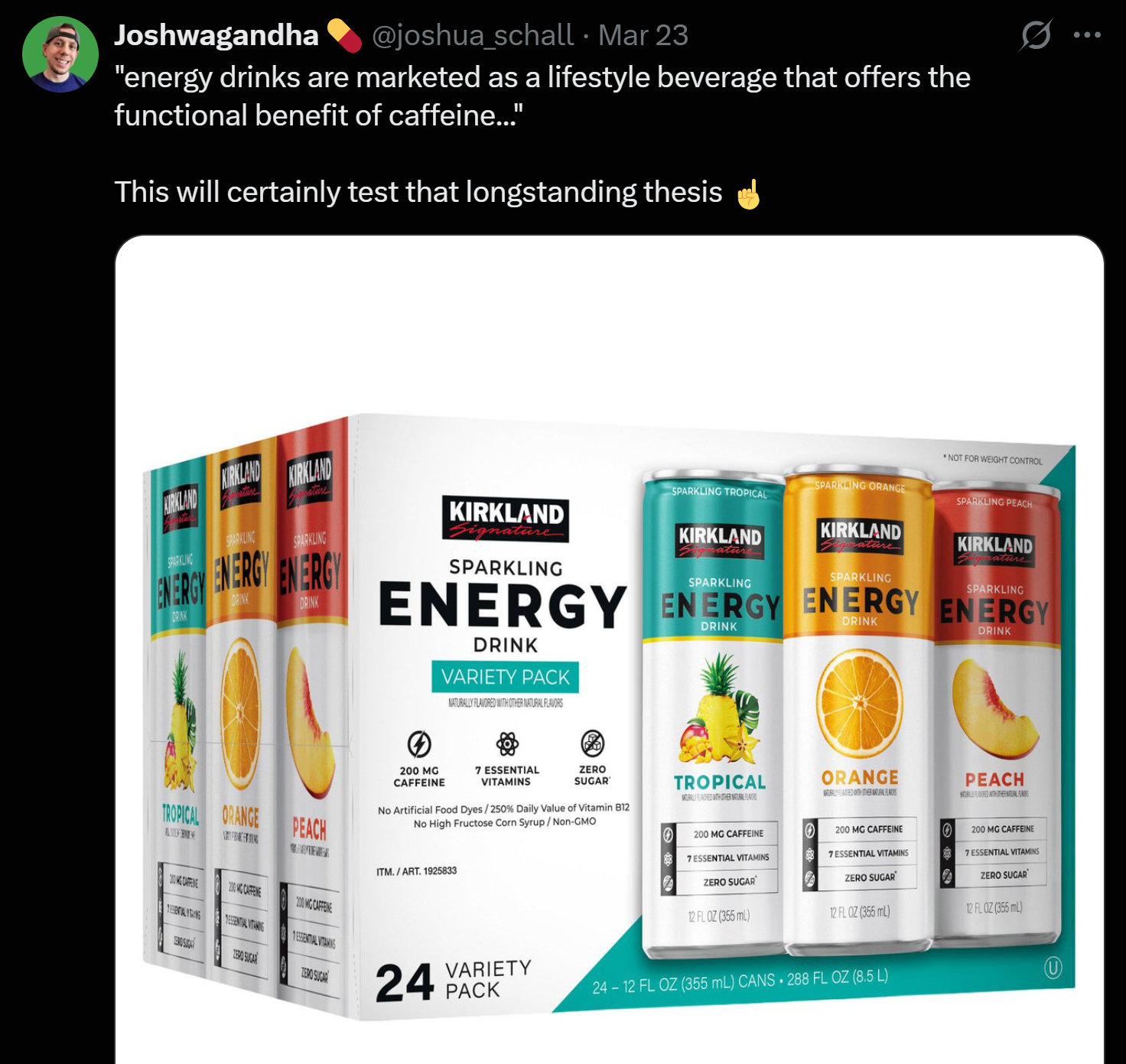
In today’s world, there are as many energy drinks as there are personalities, and your choice can say a lot about you and your personality. To go one step further…energy drinks have become status symbols or basically aspirational mixtures, representing lifestyle “taste” and identity by association. It has honestly gotten to this point where your energy drink can say just as much about you as the outfit you choose to wear.
Why is this important?
If you haven’t been paying close attention, many of the biggest categorical success stories of recent years have come to energy drink brands reaching toward female consumers. And even amongst the categorical average purchasing behavior focused on “badge value,” female consumers are especially brand loyal and looking for more than functional ingredients.
However, when initially seeing these so-called CELSIUS dupes, I made the above statement because Costco is really the only U.S. retailer possessing the needed strategic levers that could wreck my longstanding RTD Energy category thesis.
Will these Kirkland Signature energy drinks directly (and indirectly) push categorical private label penetration higher in the next three years? Yes!
Will these Kirkland Signature energy drinks sell extremely well? Yes!
But when trying to decide if these Kirkland Signature energy drinks can truly disrupt CELSIUS, it likely hinges on if Gen Z and Millennial women break historical patterns on categorical consumer behavior. While a 25-year-old Sophia (living in Austin, TX) might drink the “CELSIUS dupes” in private…is she willing to confidently carry a can of Kirkland Signature energy drinks in public everyday?
That’s something I’m paying close attention to, especially as Costco is accelerating the "cool factor” of its Kirkland Signature brand.